Showing posts with label Ben Bernake. Show all posts

Tuesday, August 9, 2011

Lets Take A Moment To Dissect Bernake's Latest Zero Interest Rate Policy

by: Bruce Krasting / ZeroHedge.com


I had this to say last week:
The Fed could easily attempt to buy some market peace by issuing a statement that the policy of zero interest rates would be extended for a minimum period of one year. I consider this to be a “high probability" to happen in the next 30 days.
I got it right, but I got it completely wrong. I feared that the Fed could extend the ZIRP language for as long as a year. Not in my wildest dream did I think they could take the extremely risky move of guaranteeing that interest rates will remain at zero for another 24 months.

Having been shocked, my thoughts.


*This action is indefensible on economic merits. This move is not motivated by sound monetary policy. It’s motivated by politics. This is a payback to Obama. Shame on the Fed for mixing politics with money.

*We will not go two years with this monetary policy without inflation (measured by core) exceeding the previously stated commitment by Bernanke that policy would not be allowed to rise above 2%. Bernanke and the dove members that signed onto this policy have lied to the American people. Bernanke has done it on 60 Minutes. He has done it to Congress. Shame on all of them.

*The Fed has taken away its ability to react to a situation that would require them to tighten. We are now on a one-way street. There is no way to turn around anymore. I believe the Fed has abdicated its responsibilities under the dual mandate. The have no ability to react if inflation should pop up in a year from now. Even worse, they have no policy options should there be a run on the dollar. The possibility of a run on the buck has gone up exponentially as a result. Should that happen, the Fed will have left us economically defenseless. Shame on the Fed for making us more vulnerable to a speculative attack.

*The stock market run up this afternoon is the Bernanke Put at work. Lets be clear on the consequences of Perpetual ZIRP. From this day onward every buy and hold investor who acquires Treasury debt with maturities of less than five-years is GUARANTEED TO LOSE MONEY. So if you accept that, then stocks have to look better. Shame on the Fed for debasing money and punishing savers.
*We have only one monetary policy. Juice stock multiples. This is the farthest thing from “Progressive” economics as you can get. We have a policy in place that is designed to make wealthy people wealthier. At some point there will be a social cost to this. The fires and riots in London were triggered by a shooting. Underneath is a rage between haves and have nots. Shame on the Fed for rigging the outcome for fat cats. Double shame on them for when our streets are filled with rage.

*Zero interest rates also means Zero risk. I think the change in Fed language will exacerbate recent short-term funding liquidity. I think we will see this appear (again) sooner versus later. I think Zero interest rates discourages leveraged investing. This policy will dry up liquidity in the asset backed market (Shadow banking system). I'm looking for evidence of this in the Euro Dollar funding markets. I am also looking for it to occur in the Term Commercial Paper market. Shame on the Fed for setting us up for this systemic risk.

*Brazil, Argentina, Korea, Indonesia are going to scream bloody murder over perpetual ZIRP. Russia is likely to get downright ugly with their rhetoric. I wouldn’t be surprised if they took this opportunity to vote with their feet and just abandon the dollar as a reserve holding. China will also make noise. They will make more calls for a new international currency to replace the dollar. The Central bankers in Japan and Switzerland are puking in the trashcan over this. Bernanke is exporting US deflation to them. Shame on the Fed for pursuing Beggar my neighbor policies. They deserve all the global criticism they are about to get.

*Bernanke bills himself as a student of the Depression. He has said over and over that he would not make the mistakes that the Fed made in 1937 when a tightening of monetary policy triggered another wave of deflation. I think the history books will look at the Fed and August of 2011 and draw a similar conclusion. At a critical time in history the Fed has taken action. The mistake of 72 years ago DID cause a recession that lasted a few years. The mistakes of 2011 will mark a point in history where America turned a corner downward. One that will take a few decades to recover from. The history books will shame Ben.

Sunday, August 7, 2011

Black Monday? - Economic Collapse A Mathematical Certainty, The Top 5 Places Where Not To Be When It Happens!

The dollar collapse will be the single largest event in human history. This will be the first event that will touch every single living person in the world. All human activity is controlled by money. Our wealth,our work,our food,our government,even our relationships are affected by money.

No money in human history has had as much reach in both breadth and depth as the dollar. It is the de facto world currency. All other currency collapses will pale in comparison to this big one. All other currency crises have been regional and there were other currencies for people to grasp on to.

This collapse will be global and it will bring down not only the dollar but all other fiat currencies,as they are fundamentally no different. The collapse of currencies will lead to the collapse of ALL paper assets. The repercussions to this will have incredible results worldwide.


Full transcript----

 "There is no greater disaster that to underestimate danger. Underestimation can be fatal.

The Dollar Collapse will be the single largest event in human history. This will be the first event that will touch every single living person in the world. All human activity is controlled by money. Our wealth, our work, our food, our government even our relationships are affected by money.

No money in human history has had as much reach, in both breadth and depth as the dollar. It is the defacto world currency. All other currency collapses will pale in comparison to this "big one." All other currency crises have been regional and there have always been other currencies for people to grasp onto. This collapse will be global and it will bring down not only the dollar but all other fiat currencies as they are fundamentally; no different.

The collapse of currencies will lead to the collapse of all paper assets. The repercussions to this will have incredible results worldwide. The dollar is the world's currency. It supports the global economy in setting foreign trade; most importantly the petro-dollar trade. This fuels our corporate vampires and acquires and harvests' the wealth of the world.

The corporate powers suppress real assets like natural resources and labor to provide themselves with massive profits. The fascist statists, collectivist's model provides the money to the economy to fun an ever-increasing federal government. That government then grows larger and larger, enriching its minions, with jobs to control their fellow citizens. Finally to come full circle; the government then controls other nations through the military-industrial complex.

This cycle will be cut when the mathematical and inevitable collapse of the dollar occurs. In order for our debt-based money to function we must increase the DEBT every year in excess of the debt and interest accrued the year before, or we will enter a deflationary death spiral. When Debt is created, money is created. When the debt is paid-off money is destroyed. There is never enough to pay off the debt because there would be not one dollar in existence,

We are at a point where we either default on the debt, willingly or unwillingly or create more money or debt: To keep the cycle moving. The problem is if you understand anything about compounding interest is that we are reaching the hockey-stick-moment (on the graph that is the moment when everything goes vertical); where the more debt that is incurred the more debt that is incurred the less effective it is: And this leads us to hyper-inflation. There are only two actors needed for this hyper-inflation: The lender of last resort, or the FED, and the spender of last resort the government. These two can and will blow up the system.

I believe they will wait until the next crises and the whiff of deflationary depression before they fire up the printing presses. That crisis is coming very soon, at the end of the summer or fall. The money and emergency measures are worn-out. The fact that none of the underlying problems that caused the 2008 crises have been resolved: The only thing that has happened is that instead of corporate problems we now have national problems.

In this movie Greece will play the role of Leman Brothers and the United States will play the role of AIG. The problem is there is no where (left) to kick the can down the road: And there is no world-government to absorb the DEBT- yet. So this leads me to the top five places NOT to be when the dollar collapses.

Number 1, Israel. This Anglo-American beachhead in the Middle-East was first conceived by the most powerful family in the world; the Rothschilds in 1917. The Balfour Declaration said that there will be a Zionist Israel , years before WWII, and the eventual establishment of Israel. Israel has not been a very good neighbor to the Muslim nations: And has always had the world's two biggest bullies on the block at its back. When the dollar collapses the United States will have much too much on its plate, both domestically and internationally to worry about such a non-strategic piece of land. This will leave Israel very weak at a time when tensions will be high. This very thin strip of desert land will not be able to withstand the economic realities of needing to import its food and fuel or the political reality of being surrounded by Muslims.

Number 2, Southern California, the land of fruits and nuts turns into Battlefield Los Angeles . Twenty-million people packed into an area that has no water and thus food is not good to say the least. Throw on top of the huge wealth disparities, and the proximity to a narco-state and this does not bode well. We have seen riots from Rodney King. What will happen when the dollar is destroyed and food and fuel stop coming into this area? People will get desperate and do crazy things especially when a huge proportion of its citizens are on anti-depressants. If food and fuel cannot get in, what about Prozac? At a time when people's worlds are falling apart they lack the ability to deal with this new paradigm. If people come off these drugs too fast they will suffer psychotic breaks and you will thousands of shootings or suicides.

Number 3, England the land of the former Big Brother and the Empire of the worldwide slave and drug trade; will suffer heavily.

The "Stiff upper lip" that the British Elite ingrained in to the sheeple will not work anymore, as the British population explodes. The humans character will sacrifice for a foreign enemy, but not if the enemy has always been the elite. The Anglo-American Empire may pull off another false flag to distract its population but I feel this collapse will happen before they pull it off. This will make all eyes point at the British Elite as being solely responsible for this catastrophe. We have seen massive riots for soccer-matches with Hooligans. What will happen when this island with very little food and fuel gets cut off?

Number 4, New York City ; another large urban area living too high on the dollar-hog. There is little doubt that all of the wealth in New York City , New Jersey , and Connecticut is derived off of Wall Street Wealth. The savings and investments of the whole nation and much of the world flows through this financial capital. As the world wakes up to the massive financial fraud; this will lead to the destruction of capital like we have never seen before (the picture is of NYC in ruins just as Berlin looked after the West bombed it into Oblivion at the end of WWII).This will have tremendous effects upon the regional economy, as people driving in Mercedes suddenly wonder where their next meal is coming from.

Number 5, Washington D.C. The political collapse of the Federal Government will reek havoc on the hugely inflated local economy as more and more states find it necessary to assert their natural control the federal government will suddenly lose power and importance, as the whole world suffers from a global Hurricane Katrina (the city in flames).

The money that they create and spend will become worthless and government minion's pensions will evaporate. Millions that once relied upon the ability to force others to send their money to them, will learn that the real power has always been at the most local level. Massive decentralization will be the answer to 'Globalization Gone Mad. ' Local families and communities will forego spending money and power out of their communities as they will care about their next meal and keeping warm. As Ayn Rand once said: "You can ignore reality, but you cannot ignore the consequences of ignoring reality."

To sum those areas that have lived highest on the hog on the dollar-paradigm will most-likely be the worst places to live, when the dollar collapses. Many of you will see this video with passing interest; but rest
assured this dollar collapse is coming!

It is a mathematical inevitability. We will not be as fortunate to muddle through this collapse, like we did in 2008, when it was a corporate problem." This time around it is a national and a global problem. The global Ponzi-Scheme has run out of gas: As the demographics decline; as cheap abundant oil declines, as hegemonic power declines: This comes at a time when we reach the exponential or collapse-phase of our money.

The irresistible force paradox says; "what happens when an unstoppable force meets an immovable object: We are about to find out, when infinite money hits a very-finite world!

Friday, August 5, 2011

Marc Faber: "Next Week We Will See If Bernanke Is A True Money Printer Or Just An Amateur"

"The whole world is mad" - so says Marc Faber when beginning his latest observations of the markets in the attached Bloomberg TV interview. "Stocks will be dropping 30%, then rallying 20%, and dropping another 30% -  that's going to be the pattern. And whoever can't live with that shouldn't be buying equities at all." And while the publisher of the Gloom, Boom & Doom report, said "there is a case to be ultrabearish about everything, and markets are going to go lower" he notes that markets are "extremely oversold" and he expects a "snap-back" rally in the U.S. Standard & Poor's 500 Index of about 40-50 points.


That said, Faber sees no new highs in 2011. He concludes that he can already smell QE3, and that the "next week will be important to see if Bernanke is a true money printer or an amateur, and if he is a true money printer he will start printing soon." We are confident that gold can't wait to find out the answer.

Monday, July 25, 2011

Gold And Silver: We Were Right – They Were Wrong


by Brandon Smith of Alt Market

Only now, after three years of roller coaster markets, epic debates, and gnashing of teeth, are mainstream financial pundits finally starting to get it. At least some of them, anyway. Precious metals have continued to perform relentlessly since 2008, crushing all naysayer predictions and defying all the musings of so called “experts”, while at the same time maintaining and protecting the investment savings of those people smart enough to jump on the train while prices were at historic lows (historic as in ‘the past 5000 years’).  

Alternative analysts have pleaded with the public to take measures to secure their hard earned wealth by apportioning at least a small amount into physical gold and silver. Some economists, though, were silly enough to overlook this obvious strategy. Who can forget, for instance, Paul Krugman’s hilarious assertion back in 2009 that gold values reflect nothing of the overall market, and that rising gold prices were caused in large part by the devious plans of Glen Beck, and not legitimate demand resulting from oncoming economic collapse:

To this day, with gold at $1600 an ounce, Krugman refuses to apologize for his nonsense. To be fair to Krugman, though, his lack of insight on precious metals markets is most likely deliberate, and not due to stupidity, being that he has long been a lapdog of central banks and a rabid supporter of the great Keynesian con. Some MSM economists are simply ignorant, while others are quite aware of the battle between fiat and gold, and have chosen to support the banking elites in their endeavors to dissuade the masses from ever seeking out an alternative to their fraudulent paper. The establishment controlled Washington Post made this clear with its vapid insinuation in 2010 that Ron Paul’s support of a new gold standard is purely motivated by his desire to increase the value of his personal gold holdings, and not because of his concern over the Federal Reserve’s destructive devaluing of the dollar!

So, if a public figure owns gold and supports the adaptation of precious metals to stave off dollar implosion, he is just trying to “artificially drive up his own profits”. If he supports precious metals but doesn’t own any, then he is “afraid to put his money where his mouth is”. The argument is an erroneous trap, not to mention, completely illogical.

Numerous MSM pundits have continued to call a top for gold and silver markets only to be jolted over and over by further rapid spikes. Frankly, it’s getting a little embarrassing for them. All analysts are wrong sometimes, but these analysts are wrong ALL the time. And, Americans are starting to notice. Who beyond a thin readership of mindless yuppies actually takes Krugman seriously anymore? It’s getting harder and harder to find fans of his brand of snake oil.

Those who instead listened to the alternative media from 2007 on have now tripled the value of their investments, and are likely to double them yet again in the coming months as PM’s and other commodities continue to outperform paper securities and stocks. After enduring so much hardship, criticism, and grief over our positions on gold and silver, it’s about time for us to say “we told you so”. Not to gloat (ok, maybe a little), but to solidify the necessity of metals investment for every American today. Yes, we were right, the skeptics were wrong, and they continue to be wrong. Even now, with gold surpassing the $1600 an ounce mark, and silver edging back towards its $50 per ounce highs, there is still time for those who missed the boat to shield their nest eggs from expanding economic insanity. The fact is, precious metals values are nowhere near their peak. Here are some reasons why…

Debt Ceiling Debate A Final Warning Sign
If average Americans weren’t feeling the heat at the beginning of this year in terms of the economy, they certainly are now. Not long ago, the very idea of a U.S. debt default or credit downgrade was considered by many to be absurd. Today, every financial radio and television show in the country is obsessed with the possibility. Not surprisingly, unprepared subsections of the public (even conservatives) are crying out for a debt ceiling increase, while simultaneously turning up their noses at tax increases, hoping that we can kick the can just a little further down the road of fiscal Armageddon. The delusion that we can coast through this crisis unscathed is still pervasive.

Some common phrases I’ve heard lately: “I just don’t get it! They’re crazy for not compromising! Their political games are going to ruin the country! Why not just raise the ceiling?!”

What these people are lacking is a basic understanding of the bigger picture. Ultimately, this debate is not about raising or freezing the debt ceiling. This debate is not about saving our economy or our global credit standing. This debate is about choosing our method of poison, and nothing more. That is to say, the outcome of the current “political clash” is irrelevant. Our economy was set on the final leg of total destabilization back in 2008, and no amount of spending reform, higher taxes, or austerity measures, are going to change that eventuality.

We have two paths left as far as the mainstream economy is concerned; default leading to dollar devaluation, or, dollar devaluation leading to default. That’s it folks! Smoke em’ if you got em’! This train went careening off a cliff a long time ago.

If the U.S. defaults after August 2nd, a couple of things will happen. First, our Treasury Bonds will immediately come into question. We may, like Greece, drag out the situation and fool some international investors into thinking the risk will lead to a considerable payout when “everything goes back to normal”. However, those who continued to hold Greek bonds up until that country’s official announcement of default know that holding the debt of a country with disintegrating credit standing is for suckers. Private creditors in Greek debt stand to lose at minimum 21% of their original holdings because of default. What some of us call a “21% haircut”:

With the pervasiveness of U.S. bonds around the globe, a similar default deal could lead to trillions of dollars in losses for holders. This threat will result in the immediate push towards an international treasury dump.
Next, austerity measures WILL be instituted, while taxes WILL be raised considerably, and quickly. The federal government is not going to shut down. They will instead bleed the American people dry of all remaining savings in order to continue functioning, whether through higher charges on licensing and other government controlled paperwork, or through confiscation of pension funds, or by cutting entitlement programs like social security completely.

Finally, the dollar’s world reserve status is most assuredly going to be placed in jeopardy. If a country is unable to sustain its own liabilities, then its currency is going to lose favor. Period. The loss of reserve status carries with it a plethora of very disturbing consequences, foremost being devaluation leading to extreme inflation.

If the debt ceiling is raised yet again, we may prolong the above mentioned problems for a short time, but, there are no guarantees. Ratings agency S&P in a recent statement warned of a U.S. credit downgrade REGARDLESS of whether the ceiling was raised or not, if America’s overall economic situation did not soon improve. The Obama Administration has resorted to harassing (or pretending to harass) S&P over its accurate assessment of the situation, rather than working to solve the dilemma:

Ratings company Egan-Jones has already cut America’s credit rating from AAA to AA+:

Many countries are moving to distance themselves from the U.S. dollar. China’s bilateral trade agreement with Russia last year completely cuts out the use of the Greenback, and China is also exploring a “barter deal” with Iran, completely removing the need for dollars in the purchase of Iranian oil (which also helps in bypassing U.S. sanctions):

So, even with increased spending room, we will still see effects similar to default, not to mention, even more fiat printing by the Fed, higher probability of another QE announcement, and higher inflation all around.
This period of debate over the debt ceiling is liable to be the last clear warning we will receive from government before the collapse moves towards endgame. All of the sordid conundrums listed above are triggers for skyrocketing gold and silver prices, and anyone not holding precious metals now should make changes over the course of the next month.

What has been the reaction of markets to the threat of default? Increased purchasing of precious metals! What has been the reaction of markets to greater spending and Fed inflation? Increased purchasing of precious metals! The advantages of gold and silver are clear…

European TARP?
The MSM blatantly glossed over the EU decision on the latest Greek bailout, as many pundits heralded the plan as decisive action on the part of Europe. But, what was the EU solution to the possibility of Greek default? In the end, their solution was to LET GREECE DEFAULT! Brilliant!

EU proponents of the plan for Greece are calling the solution a “selective default”, which I suppose, is meant to make it sound less default-ish. However, this is, indeed, a default, and many Greek bondholders are going to lose substantial sums of money as the Greek government decides who they are going to pay back, and who they are going to give the finger. Strangely, this plan also includes the creation of a kind of European Monetary Fund, or a European TARP. This means a broader strategy is being put into motion that involves continuing bailouts and fiat injections of Euros, not just into Greece, but into other countries as well, including Ireland, Portugal, Spain, and even Italy:

Extended printing of Euros means devaluation, and devaluation means greater international interest in gold and silver. The EU Council plan is a blinding flashing neon sign telling us to BUY PRECIOUS METALS, while we still can.

Stock Market Facade Is Over And Inflation Is Here
The “great bull run” over the past two years has been somewhat successful in fooling a certain percentage of Americans into believing all the recovery talk was real. The fundamentals, though, show that this run is entirely fabricated. Besides a static real unemployment rate of around 20%, housing market hellfire, and crushing inflation in commodities, trading volume in stocks is also at a three year low:

This means that the overall value of the Dow is being driven by a much smaller pool of investors. A smaller pool of active investors means a more volatile market, with a greater chance of wild swings or inflated values. This lack of stock participation also leads one to question the validity of the bull run as a whole. What, we might ask, has really been holding the markets up for so long, if so few people are feeding the machine?

We must keep in mind that since the credit crisis began the Fed has held interest rates at near zero. That’s almost 3 YEARS of near zero interest rates; far beyond the predictions of many mainstream analysts. The reason? Easy fiat from the Fed is the only thing keeping markets alive. Without it, they would crumble. We hear only of the fiat pumped into the system through bailouts and quantitative easing, but rarely do we hear about all the printing that goes on in-between these public events. The extent of Fed currency creation is made more apparent by the St. Louis Fed’s Adjusted Monetary Base:


According to the Fed publication ‘Monetary Base In An Era Of Financial Change’, the AMBSL is an index measuring the central bank balance sheet, including open market operations, statutory reserve requirements, and foreign exchange market interventions. The index, though, includes only what is reported by the fed, and without an audit, it is impossible to determine its accuracy. In all likelihood, it actually under-reports the amount of fiat being flooded into markets.

Can the Fed prop up the markets forever? No. The volume versus value conflict is too revealing, and I believe we have reached a point at which the weight of negative data is preventing any further significant climbs in the Dow even in the face of manipulation. A kind of critical apex is created; a point at which two forces once balanced meet and derail each other. Stocks, at this time, are very vulnerable, especially when they are supported by a central bank induced fiat framework.

When investors realize that the bull run is fake, not to mention over for a very long time, that dollar devaluation is a certainty, and that bonds are a deathtrap, where will they turn to protect their savings? That’s right…gold and silver. The price potential for metals going into the final half of 2011 is extremely high. Lows can strike abruptly, and they do often under such volatile circumstances, but unlike MSM talking heads, we look well beyond week to week progressions. The long term trend is really what matters, and the long term trend for gold and silver has been impressively positive.

To those who chose not to take my advice over the past three years, or the advice of countless other alternative analysts and economists, I can only say we stand by our record. Our purpose is to help you secure the safety of your buying power as much as possible in these dangerous days. That is all. It is not too late to establish a foundation in precious metals, and it is not too late to accept the reality of our country’s quandary. Warnings, though, are just a small window in time, and they are only useful, so far as they are heeded.

Friday, June 24, 2011

"Stealth QE3" Comes to Fruition – Soaring Inflation is Next

By David Zeiler
Associate Editor, Money Morning

U.S. Federal Reserve Chairman Ben Bernanke did what most everyone expected Wednesday at the culmination of the Federal Open Market Committee's (FOMC) two-day meeting - he left average Americans vulnerable to the pangs of higher prices and soaring inflation.

Indeed, as yet another FOMC meeting drew to a close without any significant policy changes, the central bank, as many predicted, kept interest rates at 0% to 0.25%, where they've been since December 2008.

And citing weaker than expected economic growth, the FOMC vowed to remain in an "accommodative stance" by retaining its huge $2.832 trillion portfolio of securities and loans.

The Fed will do this by using the money from maturing bonds and principal payments from its securities holdings to buy more bonds "according to a distribution that is nearly identical to that executed under the Treasury purchase program," according to the New York Fed statement - an extension of the quantitative easing (QE2) program in all but name.

Money Morning Chief Investment Strategist Keith Fitz-Gerald saw this "stealth mode" QE3 coming.

"Instead of printing more money, the Fed is likely to start reinvesting the proceeds of maturing debt," Fitz-Gerald said. "Ultimately, that won't reduce our government's bloated, toxic balance sheet. But it will change the makeup of that balance sheet - and not for the better."

By keeping interest rates at historic lows and continuing to reinvest in maturing debt, rather than retiring it, the U.S. Federal Reserve runs the risk of feeding an inflation rate that in recent months has risen to uncomfortable levels.

But that's something Bernanke has sought to acknowledge without taking responsibility.

"Inflation has moved up recently, but the [Fed] anticipates that inflation will subside... as the effects of past energy and other commodity price increases dissipate," the FOMC said in its statement.

When judging inflation, the Fed uses the core consumer price index (CPI), which excludes food and energy. In May the core CPI rose 1.5%, the most since January 2010 but below the Fed's informal target of 2%.

In his remarks yesterday, Bernanke said he favors the Fed setting an official inflation target, but the FOMC has set no timetable to do so.

Meanwhile, the full CPI increased 3.6% in May, the most since October 2008. Although the Fed likes the core CPI because it avoids volatility, many - including some within the Fed itself - believe the full CPI more accurately reflects the real-world experience of the U.S. consumer.

"One immediate benefit of dropping the emphasis on core inflation would be to reconnect the Fed with households and businesses who know price changes when they see them," James Bullard, president of the Fed Bank ofSt. Louis, said last month.

Fitz-Gerald was more blunt.

"Companies are, in fact, passing along costs as fast as they can," he observed in May. "McDonald's Corp. (NYSE: MCD), Nestle SA, and Wal-Mart Stores Inc. (NYSE: WMT) are just a few of the companies that have spoken out about the specific impact that higher component and ingredient costs have had on their earnings. Many have adjusted their guidance."

Making inflation even harder on average Americans is an unemployment rate of 9.1% and slumping wages. Average hourly earnings fell 1.6% in May.

Of course, using the core CPI number allows the Fed to sweep inflation rate concerns under the rug to pursue policies it believes will stimulate a stubbornly sluggish U.S. economy.

Yet those policies could ultimately prove ruinous to the U.S. economy.

"Be warned: There is every chance that the Fed will lose control, inflation will spiral - and not just to the ruinous levels we saw in the 1970s, but well beyond them, too," Money Morning Contributing Editor Martin Hutchinson said recently. "Inflation may become much more acute - reaching the excruciating/ruinous 20% to 50% level - rather than reaching and then holding steady at the uncomfortable-but-bearable 10% level.

"Even after that occurs, Bernanke will refuse to launch any sort of significant counterattack, or combat it," Hutchinson continued.

Ultimately, the Fed's buying binge could cause a runaway inflation rate that would create a crisis for the U.S. dollar.

"With the U.S. market straining under the burden of rising inflation and some ill-advised monetary and fiscal moves, the death of the dollar is looming as a worst-case -- but still possible - scenario," Hutchinson said.

Monday, June 20, 2011

Bernanke to Invent New Term for Printing Money


When the U.S. Bureau of Labor and Statistics (BLS) reported their latest consumer price index (CPI) inflation data last week, everybody in the mainstream media worked tirelessly to spin the data in order to proclaim that U.S. price inflation is not a problem. Most articles in the media reported that inflation slowed in May due to falling gas prices. The truth is, gas prices rose last month and U.S. price inflation is spiraling out of control.


Price inflation based on the CPI on a year-over-year basis rose during the month of May to 3.57%, up from 3.16% in April, 2.68% in March, 2.11% in February, 1.63% in January, 1.5% in December, and 1.1% in November. The official rate of price inflation has more than tripled over the past 6 months. Yes, maybe the rate of year-over-year price inflation rose by slightly less in May over April, than it did in April over March, but this isn't good news at all. This U.S. dollar is still rapidly losing its purchasing power and the rate at which it is declining in purchasing power is accelerating.

On an unadjusted basis, gas prices rose 3.6% in the month of May. The media is reporting gas prices based on the BLS's seasonal adjustments. Only with the BLS's deceptive seasonal adjustments did gas prices decline by 2% in the month of May. The BLS's seasonal adjustments will actually reverse starting in the month of July and add to reported gasoline prices. NIA predicts that come August when the BLS releases its July CPI report, the media will begin focusing on unadjusted gasoline prices because the unadjusted gain will be less than the adjusted one. The media always reports the data that supports their agenda and ignores the data that works against it.

The media is obviously just saying what the U.S. government wants them to say. Larry Summers, a Keynesian economist who served for 5 years last decade as President of Harvard and was up until late-2010 director of President Obama's White House National Economic Council, just said last week that, "the underlying rate of inflation is still trending downwards". The media's favorite economist Paul Krugman, a Keynesian who has an op-ed column in the New York Times, said last week that, "There’s really nothing here to shake my view that deflation, not inflation, is the threat."

Krugman, who has been calling for massive price deflation the whole entire time that NIA has been predicting massive price inflation, is refusing to admit he has been wrong and is telling all Americans to ignore rapidly rising food and energy prices because he claims they are too volatile. He is telling the world to focus solely on the core CPI, which ignores food and energy, the two items that Americans need most to live and survive. Core CPI is weighed heavily by rents and America's Real Estate bubble still isn't done deflating. The only purpose of having a core CPI is for Keynesian economists like Krugman to use it to mislead Americans and deceive them into believing that inflation is not a problem.

Core CPI was an invention of the Nixon administration, which right there should tell you all you need to know about it. President Nixon's idea for creating core CPI, was to deceive Americans about price inflation by excluding the items that were rising the most, which he would justify by calling these items "too volatile". NIA has predicted from the very beginning that inflation will not effect all goods and services equally and that as inflation begins to spiral out of control, inflation would gravitate most towards the prices of the items that Americans need the most, and there is nothing that Americans need more than food and agricultural products, and to a lesser extent energy.

Whenever the mainstream media reports about global inflation and they show a map of the world, the map always shows massive inflation in Middle Eastern and Asian countries, with the U.S. having the least price inflation. The truth is, inflation in Middle Eastern and Asian countries isn't many times worse than the U.S., it is just that their governments are many times more honest and aren't as advanced in manipulating economic statistics as our government is. While all of the headlines from major American news organizations about U.S. inflation said last week that inflation is slowing and not a problem, those same news organizations wrote articles about Chinese inflation being at a new 34-month high of 5.5%. The fact is, official U.S. price inflation is also at its highest level in nearly three years and our real price inflation rate is actually higher than China's reported rate of price inflation.

Based on the BLS's CPI, year-over-year U.S. price inflation in the month of May of 3.57% was the highest year-over-year price inflation rate since October of 2008, right before the global financial crisis. If it wasn't for the global financial crisis of late-2008/early-2009 and the world's mistake of liquidating real assets and hoarding fiat U.S. dollars as a safe haven, it is likely that the official rate of U.S. price inflation would already be in the double-digits today. NIA estimates the real rate of U.S. price inflation, minus geometric weighting and hedonics, to currently be approximately 7.5% on a year-over-year basis. It is possible that the real U.S. price inflation rate will reach double digits in the second half of 2011. That will be devastating to the U.S. economy because at that point it will just about guarantee that the Federal Reserve will have to raise the federal funds rate to north of 10% by the middle of this decade.

The Federal Reserve's balance sheet just reached a brand new record of $2.832 trillion, up from $2.815 trillion in the prior week, as we approach the end of QE2 at the end of June. The stock market is already anticipating the end of QE2 with the Dow Jones currently down over 900 points from its high at the end of April. The declining stock market is pretty much sowing the seeds for a QE3. After all, Federal Reserve Chairman Ben Bernanke doesn't want to see the phony U.S. economic recovery blow up in smoke.

Bernanke will do everything possible to disguise QE3 and will never admit to there being a QE3. Remember, this is the same Federal Reserve Chairman who lied to every single American on '60 Minutes' when he said, "We're not printing money." That is exactly what QE2 is, printing money, but just like how Bernanke won't admit to printing money, Bernanke is now going to retire the term "quantitative easing" and come up with a new term for the Fed's latest destructive policy of creating massive monetary inflation.

Saturday, May 14, 2011

Inflation Is Already Here


The recent correction in the commodities markets may be providing Bernake, Geithner and their easy money acolytes with a sense of relief given the relentless run up in prices of raw materials since the announcement of QE back in 2008, but they should not sleep tight just yet.  As anyone in the markets will tell you, when any underlying commodity has a price move so vertical in its trajectory it’s bound to face a correction as the smart money, having gotten in for fundamental reasons much earlier along the trend line now wait for the panic buyers or the Johnny-come-lately’s to give the rally that last unsustainable spike to unload their longs and leave the suckers holding $40.00 silver in their purses.

 So one must step back and take a long view.  Although it would appear that those of us who warn that inflation is not just a threat but very much a fact of life now were knee-jerk pontificators jumping on the commodities rally trend for political (read: Fed/Obama bashing) reasons, the analysis is quite sound.  Most important, it is methodical not emotional as price surges tend to make investors and analysts from time to time.

Here are some facts: even with the inevitable correction in commodities, as of this writing crude oil is 35% more expensive than it was a year ago…advancing with ups and downs along the way from as low as $17.50/bbl in November of 2001 to its current level of over $100/bbl or around a 19% annual appreciation in a decade since the Fed started giving away dollars.  In that same year silver is still up 93%   Wheat 84%. Cotton 100%  Coffee 55%. Cattle 10%, etc.  In that same decade the USD index against all currencies shed 40% of its value.  Gold is up 22% for the year.  More revealing, the most precious metal and most stable of exchange mechanisms is up an astonishing 450% since 2001. Put another way, whereas the dollar was worth 1/250th of an ounce of gold in 2001, it is now only worth 1/1500th.  Money can be printed with much more ease and speed than gold can be mined.

To understand why the Bernake’s and Geithner’s of the world view CPI through rose-tinted glasses we must remember who they are.  They are wonks who have spent their entire careers lecturing and/or fidgeting with economies without actively participating in them.  They are awash in data and are hardwired to extrapolate patterns from the past to predict the future.  But we have only had a non-gold fiat monetary system in place since 1971 which is hardly enough time to get a handle on repeating macro-economic cycles in such an ever changing and dynamic landscape.  And I want to offer something else.  From the late 1940s to the mid-1980s the United States was the dominant manufacturer in the world.  The reason?  Of our three main foreign competitors today, China, Japan and Germany, one was mired for much of the third quarter of the 20th Century in a disastrous experiment with Maoist communism while the latter two’s urban centers had been reduced to utter wasteland as their reward for launching the most devastating war in human history.  Indeed, all of Europe was digging out of the wreckage of their mass-fratricide, including a bankrupted Great Britain…once the supreme power of the world.


Into that void poured American made cars, radios, appliances, garments, food, you name it.  By the mid-1950s the US was producing almost half of the world’s manufacturing output.  Now we produce less than 20%.  So when Bernake considers whether or not rising prices will result from printing trillions of dollars he looks back to, say 1987 when the dollar index halved yet CPI was only up 4.4% in that same year.  Ergo: a falling dollar does not cause inflation.  Hence QE I and II should move forward without fear.

But he is wrong on two levels.  First of all, a weak dollar is usually a catalyst to prompt more exports as US goods become cheaper.  And indeed that has happened as the manufacturing sector has been recovering nicely.  But, those US manufacturers that once dominated the landscape are few and far between as we have surrendered our assembly lines to the forces of cheap labor overseas in favor of a service oriented economy.  So now when imported goods are more expensive due to their relative strength (or less weakness) against the dollar, unlike in the past when we could shift our purchases to cheaper US-made goods, we instead are compelled to accept higher prices as we have no choice but to buy foreign-made goods.  Ask Wall-Mart.  (One’s house would be an almost vacant four walls if we invaded it and took away any items that don’t say “Made In USA” on them!) China, for example in 1987 produced less than 5% of the world’s goods.  Now it almost a 20%.  A four-fold increase.

Secondly, the definition of inflation that most people use, including the Fed, seems to be a measure of the CPI as if the two are interchangeable.  Hence, people believe, if the CPI remains steady, so too does inflation.  But, what is inflation exactly?  Is it really price increases per se?  Or are rising prices just one symptom of a larger event?  “Inflation” is what the word implies: an inflation in the supply of a currency and thus a decrease in its value and eventually its purchasing power.  Consumer prices are not always the best measure for a variety of reasons.  Just to give one example, they tend to be ‘sticky’ in that vendors are hard-pressed to jack them up to account for lost dollar values.  So they may try other approaches to mitigate the inflated currency’s impact on the bottom line such as keeping prices the same but reducing the package size.  Care for some potato chips with your bag of air?  How about a 1.5 pint of ice cream that for the same price (hence no measurable impact on CPI) that used to be 1.75 pints?  There are many ways short of raising prices to compensate for the effects of an ever expanding supply of dollars.  But real costs rise just the same.

The fact is that inflation in its traditional definition is rampant across the globe and it can in large part be attributed to the policy of almost zero interest rates in the form of a greatly expanding balance sheet of the Federal Reserve.  Take China for example.  They are the largest exporter to the United States and as such have a vested interest in preventing their products from becoming too expensive (although they have less to fear from competitively cheap US goods as they once did).  They do this by artificially pegging the yuan to the dollar at a fixed rate.  When the Fed prints more dollars, in order to prevent their currency from appreciating as it can now buy more dollars for the same price, the Chinese must expand their own balance sheet to print the money used to buy up the excess dollars in the system and maintain their target exchange rate to keep their exports flowing.

As such, China’s M2 is up 15.3% in April alone in part due to this phenomenon. This is an inflationary policy.  There are more yuan than there used to be.  So they too are worth less, although not as less as the even more in supply US dollar.  And as you would expect, since they have real inflation, prices in China are on the rise.  Their CPI, in fact, shows a 5.3% inflation rate.  How come their CPI shows a much higher level than ours when our dollar is depreciating faster than their yuan?  It all depends on how you measure it.  The answer is that their CPI reflects real changes in commodities prices and ours discounts their impact in favor of finished goods.  So to put it simply, where their CPI places a larger import on the price of raw materials and food ours places more emphasis products like the price of a cell phone.  Considering the first Motorola cell phone retailed for $3,995 in 1983, the price has clearly gone down.

Regardless of CPI though, why would raw materials be impacted by the Fed’s relentless easing?  Well, commodities are traded in US dollars which is the world’s reserve currency so a refiner in, say Japan, who has to purchase crude oil for distillation must first take its yen and buy dollars with it before going into the market to buy crude oil.  The seller of crude knows that the yen bought its counterparty more dollars and thus will it charge more dollars for its oil, lest the next time he visits Tokyo and converts his less valuable dollars back into fewer yen he may be forced to stay in a Holiday Inn as opposed to a Ritz this visit.

To be sure, demand spurned by economic growth in the developing world is still the prime driver of raw materials price action.  Complex systems like global markets are an expression of many factors.  But if the supply/demand dynamic is what got dealers into the commodities market from the long-side, the Fed’s policies injected steroids into the rally and has now printed its way into a corner.  It cannot initiate more easing as inflation is here.  (As companies add more to their payrolls too, though good for the country as a whole, this will put ever more upward pressure on prices.)  But should it start tightening by raising interest rates as I think is inevitable, making it more expensive for businesses to borrow, it could threaten the anemic recovery that is already showing signs of slowing if the Q1 numbers are any indication.

Meanwhile the average American is being squeezed ever more by rising prices and diminishing real value of their savings.  The Fed and their enablers in the Federal City will have much to answer for in the years ahead.  “What’s happening in Washington now is destroying the class of people who save an invest,” said investment guru Jim Rogers.  “All the people who did the right thing are earning that much money right now. That’s not how the system is supposed to work.”

But that is how the overrated minds running the Fed and the Treasury, neither of whom has ever run a private business feel how the system should work.  They seem utterly incapable of understanding that the past predicts the future…until it doesn’t.   By the time we realize the world has changed and the old school approach is just that, it may be too late.

Wednesday, May 11, 2011

Forbes Predicts U.S. Gold Standard Within 5 Years

A return to the gold standard by the United States within the next five years now seems likely, because that move would help the nation solve a variety of economic, fiscal, and monetary ills, Steve Forbes predicted during an exclusive interview this week with HUMAN EVENTS.

“What seems astonishing today could become conventional wisdom in a short period of time,” Forbes said.


Such a move would help to stabilize the value of the dollar, restore confidence among foreign investors in U.S. government bonds, and discourage reckless federal spending, the media mogul and former presidential candidate said.  The United States used gold as the basis for valuing the U.S. dollar successfully for roughly 180 years before President Richard Nixon embarked upon an experiment to end the practice in the 1970s that has contributed to a number of woes that the country is suffering from now, Forbes added.

If the gold standard had been in place in recent years, the value of the U.S. dollar would not have weakened as it has and excessive federal spending would have been curbed, Forbes told HUMAN EVENTS.  The constantly changing value of the U.S. dollar leads to marketplace uncertainty and consequently spurs speculation in commodity investing as a hedge against inflation.

The only probable 2012 U.S. presidential candidate who has championed a return to the gold standard so far is Rep. Ron Paul (R.-Tex.).  But the idea “makes too much sense” not to gain popularity as the U.S. economy struggles to create jobs, recover from a housing bubble induced by the Federal Reserve’s easy-money policies, stop rising gasoline prices, and restore fiscal responsibility to U.S. government’s budget, Forbes insisted.

With a stable currency, it is “much harder” for governments to borrow excessively, Forbes said.  Without lax Federal Reserve System monetary policies that led to the printing of too much money, the housing bubble would not have been nearly as severe, he added.

“When it comes to exchange rates and monetary policy, people often don’t grasp” what is at stake for the economy, Forbes said.  By restoring the gold standard, the United States would shift away from “less responsible policies” and toward a stronger dollar and a stronger America, he said.  “If the dollar was as good as gold, other countries would want to buy it.”

An encouraging sign for Forbes is that key lawmakers besides Rep. Paul are recognizing that the Fed is straying well beyond its intended role of promoting stable prices and full employment with its monetary policies.

Forbes cited Rep. Paul Ryan (R.-Wis.), who, he believes, understands monetary policy better than most lawmakers and has shown a willingness to ask tough but necessary questions.  For example, when Federal Reserve Chairman Ben Bernanke appeared before the House Budget Committee in February, Ryan, who chairs the panel, asked Bernanke bluntly how many jobs the Fed’s quantitative-easing program had helped to create.

Politicians need to “get over” the notion that the Fed can guide the economy with monetary policy.  The Fed is like a “bull in a China shop," Forbes said.  “It can’t help but knock things down.”

“People know that something is wrong with the dollar," Forbes concluded.  "You cannot trash your money without repercussions.”

http://www.humanevents.com/article.php?id=43439

Thursday, May 5, 2011

A Dollar Collapse? No Way – The U.S. Dollar Rocks! (Propaganda)

Are we on the verge of a dollar collapse?  Don't believe the skeptics.  The truth is that there is no currency in the world that is stronger than the old greenback.  The U.S. dollar is the reserve currency of the world.  Virtually all of the nations on the face of the earth use it for trading and they always will.  Why?  Because the U.S. dollar is awesome.  No currency on earth can compete with our awesomeness.  So what that the dollar hit a new all-time record low against the Swiss franc today?  Do you really want to move over with the Swissies and eat chocolate and make watches?  No, you want to live in the land of American Idol, the NFL and apple pie - the good old USA.  Who cares if it takes about a dollar and a half to buy a single euro now?  Do you really want to go live with the Frenchies and eat a bunch of French bread while you wear a beret every day?  Of course not.  There isn't going to be a dollar collapse.  As long as the USA is still number one the rest of the world is still going to need U.S. dollars.  So quit your worrying.


The other day all of the "doom and gloomers" were crying that the sky was falling because the U.S. dollar had fallen for 8 trading days in a row.  They were proclaiming that the "end of the dollar" was near because the dollar index was approaching a new record low.

The following is how an article from yesterday in the Washington Post described the recent slide of the dollar....
The dollar has fallen against a basket of six major currencies -- the euro, Japanese yen, British pound, Canadian dollar, Swiss franc and Swedish krona -- for the past eight trading days. That measure struck its lowest point since July 2008 on Monday, at 72.72. It hit bottom in April 2008 at 71.33. Its highest point since the euro’s creation was 120.92 in July 2001.
Well guess what?

The dollar index moved back up today.

That is what happens - currencies go up and currencies go down.

There is no need to get your pants in a twist over it.

When the U.S. dollar goes down, it makes our products more affordable overseas.  When other nations buy more of our stuff that helps our businesses.

So when the dollar declines a little bit that is nothing to be alarmed about.

So far in 2011, the U.S. dollar has only lost about 6.5 percent of its value.

Should we be freaking out about a measly 6.5 percent?

I don't think so.

Do you want an even "scarier" number?

The dollar has fallen by 17 percent compared to other major national currencies since 2009.

Oooooooooohhhhhhhhhhhh - are you frightened out of your mind yet?

You better run outside Chicken Little - the sky might be falling.

The problem is that there are so many tinfoil hat wearing conspiracy theorists running around declaring that the U.S. dollar is dying that some people are actually starting to believe it.

Do you want proof that the U.S. dollar is going to be just fine?

Here you go....

Just check out what U.S. Treasury Secretary Timothy Geithner recently told the Council on Foreign Relations....
"Our policy has been and will always be, as long as I will be in office, that a strong dollar is in the interest of the country."
Bam!

You have the very words of the U.S. Treasury Secretary right there.

He has promised the we "will always" have a strong dollar policy.

Geithner has said it and that settles it.

Any questions?

Who are you going to believe?  Are you going to believe the U.S. Treasury Secretary or are you going to believe a bunch of crazy Internet bloggers with blogs with titles such as "Economic Disaster" and "The American Dream Has Been Flushed Down The Toilet"?

Let's get real.

The U.S. dollar is just fine and there is not going to be some mythical "dollar collapse".

But isn't the price of gasoline going up?

Sure it is.

But that isn't the fault of the Federal Reserve.  They don't set prices for gasoline.

The reality is that prices for different things go up and down.  That is what a free market economy looks like.
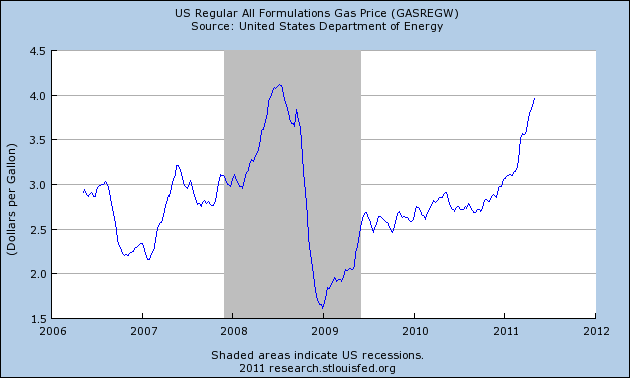
Right now the price of gasoline is actually lower than it was back in 2008....


So shouldn't we actually be talking about falling gasoline prices?

I don't know about you, but I sure am glad to be paying less for gasoline than I was back in mid-2008.

But the tinfoil hat crowd will "cherry pick" statistics to make it seem like things are worse than they really are.  They will break out scary sounding statistics such as the fact that over the past 12 months the average price of gasoline in the United States has gone up by about 30%.

LOL - cry me a river.  Life is tough.  People will cry over just about anything these days.

Who really cares that the average American driver will spend somewhere around $750 more for gasoline in 2011?

That is just a sign that the economic recovery is in full swing.

Do you know how much all of that money is going to help our oil companies?

They are going to be swimming in cash, and all of that wealth will "trickle down" and help out the folks on main street.

You would think that the half-crazed economic bloggers out there would be thrilled by all of this, but no - they just keep trotting out the "inflation boogeyman" over and over and over.

Well, you know what?

According to no less of an authority than Federal Reserve Chairman Ben Bernanke, we basically have close to zero inflation in the United State right now.

You believe the Federal Reserve, don't you?

If not, there is probably something wrong with you.

Unfortunately, we have got a whole bunch of these self-proclaimed "experts" (who are really just legends in their own minds) running around proclaiming that inflation is not calculated the same way that it used to be.

Well, you know what?  They are right.  But it isn't some great conspiracy.  The truth is that we have "improved" the way that inflation is calculated 24 times since 1978.

The government is always trying to become more accurate.

What is wrong with that?

But today we have a bunch of amateurs running around trying to tell us what the "real" rate of inflation actually is.

For example, a New York post analysis claims that the rate of inflation in New York City has been about 14 percent over the past year.

So how many prices did they measure?

A dozen?

Two dozen?

Who are you going to trust more - the Federal Reserve or the New York Post?

Perhaps the New York Post should just stick to reporting on the latest Elvis sighting and leave economics to the big boys.

If hack reporting by publications like the New York Post wasn't bad enough, we've also got numbskulls like John Williams from a website called "Shadow Government Statistics" running around proclaiming that the sky is going to fall because of U.S. government debt.

The following is a sampling of the smelly stuff that Williams is spreading around....
S&P is noting the U.S. government's long-range fiscal problems. Generally, you'll find that the accounting for unfunded liabilities for Social Security, Medicare and other programs on a net-present-value (NPV) basis indicates total federal debt and obligations of about $75 trillion. That's 15 times the gross domestic product (GDP). The debt and obligations are increasing at a pace of about $5 trillion a year, which is neither sustainable nor containable. If the U.S. was a corporation on a parallel basis, it would be headed into bankruptcy rather quickly.
Does anyone actually believe any of that nonsense?

How long has Williams been predicting that U.S. government finances are going to collapse?

Yes, he has been doing it for a very, very long time.

Has the sky fallen yet?

Are we living in an economic wasteland?

Has there been a U.S. dollar collapse?

No.

Look around you - everything is just fine.

Every time the U.S. economy has had a recession in the past, what has happened?

The economy has recovered and has gotten larger than ever.

And that is exactly what is happening again.

But sadly, there are more Americans than ever that actually believe that we are headed for economic disaster.  In fact, there are some websites where they actually debate what the best place to live in the United States will be when the "economic collapse" happens.

Can you believe that?

People need to grow up.

Yes, the U.S. government is in debt.  That should be no surprise.  U.S. government debt is normal.  The truth is that our financial system is designed to have U.S. government debt constantly expand and for there to always be a little bit of inflation in the system.

When the U.S. government goes into more debt, more money is created.  If there was no debt in our society there would be no money.

So all of these bozos that claim that they want to get rid of all government debt don't know what they are talking about.

We need to trust that the experts over at the Federal Reserve know what they are doing.  The prudent moves by Ben Bernanke have helped the economy to recover after the horrible financial crisis of 2008.

Instead of being criticized, he should be commended.  There is a reason why he was named "Person of the Year" by Time Magazine in 2009.

The Federal Reserve is watching inflation.  If it starts spiking up a little bit they will stomp it out.  They know what they are doing.

This is 2011 - the people running things were produced by some of the greatest academic institutions on the planet.  Nothing is going to catch them by surprise.  They know exactly what our problems are and how to solve them.

So quit listening to the tinfoil hat crowd.  Yes, the U.S. dollar will fluctuate a little bit relative to other major currencies.  That is nothing to be alarmed about.

There is not going to be a dollar collapse so stop waiting for one.  The U.S. dollar is always going to be the greatest currency on earth.  Why?  Because the United States is the greatest nation on earth.

After all, what other nation on earth could produce Justin Bieber, Jim Carrey, Simon Cowell, Pamela Anderson, Catherine Middleton, Michael J. Fox, Seth Rogen, Brendan Fraser, Jason Priestly, Tom Green, Ryan Reynolds, Mike Myers, Kiefer Sutherland, Howie Mandel, Keanu Reeves and William Shatner?
--------------------
Hopefully by now you have figured out that this is a satirical piece demonstrating how ridiculous much of the propaganda in the mainstream media really is.  Thank you for taking the time to read my twisted attempt at humor.

read this article and more at: theeconomiccollapseblog.com

Tuesday, May 3, 2011

Ben Bernanke’s Lone Positive Legacy: A Return To The Gold Standard

by: Bill Frezza - Forbes.com


I’ll make two predictions with utter confidence. The first is that one day Federal Reserve Chairman Ben Bernanke will be ridden out of town on a rail, joining Arthur Burns in that special circle of hell reserved for monetary debauchers. The second is that in the aftermath of our pending inflationary disaster we will see the gold standard return.


The Federal Reserve long ago lost control of inflation, now ravaging several sectors of our economy. This is obvious to every economist not a member of Bernanke’s Greek chorus, singing lyrics provided by the gnomes in the Bureau of Labor Statistics. Their modern re-interpretation of the dance of the seven veils uses statistical “adjustments” instead of scarves, but these keep the evidence of inflation as hidden as Salome’s charms. My favorite fudge has to be the “hedonic quality adjustment.” What are you going to believe, the government’s regression coefficient estimates or your own lying eyes?

What Bernanke made clear now that he launched his own reality TV show is that his primary mission is no longer ensuring a stable currency, or even pursuing the illusory goal of full employment. Rather, Helicopter Ben will make his last stand managing inflationary expectations. As long as he maintains the illusion of monetary stability the Fed’s printing presses can run flat out. What could please his masters more, who get to spend this fresh dough before it floods into the economy to dilute ours?


Reading from the playbook of successful defense attorneys the game is on to Deny, Deny, Deny! All evidence of inflation is explained as transitory. High food prices? It’s the weather. Gasoline? Blame speculators or oil industry profits. Ben knows he can get away with this dodge for at least two or three more quarters. After that? Don’t you worry; if inflation ever raises its ugly head Ben the Beneficent will rise up and smite it immediately!

Do you have a friend that is a high function alcoholic? “Back off, I can handle it! I’m doing fine at work. Things at home have never been better. What’s the big deal; it’s just a few traffic tickets. If my drinking becomes a problem I can stop any time.” After he wraps his car around a tree, loses his job, and his wife leaves him you’ll be there to check him into rehab. But his life will never be the same.

Nor will our economy after the triple whammy of double digit unemployment, double digit inflation, and an uncontrollable budget deficit comes down on our heads. That’s why I think the gold standard will make a comeback. It’s too bad the country has to be dragged through so much avoidable misery, but perhaps that’s the only way we can put a stake through the heart of fiat currency.

Don’t be melodramatic; we survived the seventies without restoring the gold standard didn’t we? Sure. But last time Washington went on an inflationary binge the world was a simpler place, and we sat firmly atop it.

There was no Euro. China was the world’s largest penal colony barely able to feed itself, not a manufacturing giant and our biggest creditor. The evil empire threatened. Fax machines were the latest thing in international communications. World financial markets were neither integrated nor interconnected by broadband. And citizens got their news from three government regulated TV networks.

Paul Volcker had a far more manageable problem dumped in his lap than will Bernanke’s successor, who will be confronted by genuine challenges to the U.S. dollar as the world’s reserve currency. And therein lies the opportunity for gold.

Faced with the alternative of ceding monetary supremacy to the Chinese the gold standard will be the only politically palatable option. In addition, all those gold cranks the liberal media spent decades portraying as fools are going to look pretty smart when gold hits $2,000 an ounce. With enough think tanks in Washington rehabilitating gold as a respectable monetary anchor and ratings agencies threatening to reduce T-bills to junk bond status, hard money will have its day in court.

And it will win because the gold standard makes but one promise, and that is to stabilize the value of money. At that task it has never failed, unlike every fiat currency in history. Gold makes no false promises to cure unemployment, direct credit to the unworthy, juice a slack economy, boost exports, deliver stealth tax hikes, erode unfunded liabilities, or all the other things that fiat currency advocates promise. A gold peg merely sets immutable ground rules for exchange and leaves us alone to work out the rest. By taking the distorting levers away from Washington elites a hard money standard grounds the economy on our own productive efforts and not the whims of bureaucrats. And productivity is a playing field on which America has always done its best.

Laugh at the gold standard if you’d like, but don’t count on laughing last. When Bernanke’s funny money takes its inevitable fall, gold will still beckon.

Fed Up with the Fed?

by: Thomas Sowell


Fed Up with the Fed?
When people in Washington start creating fancy new phrases, instead of using plain English, you know they are doing something they don't want us to understand.

It was an act of war when we started bombing Libya. But the administration chose to call it "kinetic military action." When the Federal Reserve System started creating hundreds of billions of dollars out of thin air, they called it "quantitative easing" of the money supply.

When that didn't work, they created more money and called it "quantitative easing 2" or "QE2," instead of saying: "We are going to print more dollars-- and hope it works this time." But there is already plenty of money sitting around idle in banks and businesses.


The policies of this administration make it risky to lend money, with Washington politicians coming up with one reason after another why borrowers shouldn't have to pay it back when it is due, or perhaps not pay it all back at all. That's called "loan modification" or various other fancy names for welching on debts. Is it surprising that lenders have become reluctant to lend?

Private businesses have amassed record amounts of cash, which they could use to hire more people-- if this administration were not generating vast amounts of uncertainty about what the costs are going to be for ObamaCare, among other unpredictable employer costs, from a government heedless or hostile toward business.

As a result, it is often cheaper or less risky for employers to work the existing employees overtime, or to hire temporary workers, who are not eligible for employee benefits. But lack of money is not the problem.
Those who are true believers in the old-time Keynesian economic religion will always say that the only reason creating more money hasn't worked is because there has not yet been enough money created. To them, if QE2 hasn't worked, then we need QE3. And if that doesn't work, then we will need QE4, etc.
Like most of the mistakes being made in Washington today, this dogmatic faith in government spending is something that has been tried before-- and failed before.

Henry Morgenthau, Secretary of the Treasury under President Franklin D. Roosevelt, said confidentially to fellow Democrats in 1939: "We have tried spending money. We are spending more than we have ever spent before and it does not work."

As for the Federal Reserve today, a headline in the Wall Street Journal of April 25th said, "Fed Searches for Next Step."

That is a big part of the problem. It is not politically possible for either the Federal Reserve or the Obama administration to leave the economy alone and let it recover on its own.

Both are under pressure to "do something." If one thing doesn't work, then they have to try something else. And if that doesn't work, they have to come up with yet another gimmick.

All this constant experimentation by the government makes it more risky for investors to invest or employers to employ, when neither of them knows when the government's rules of the game are going to change again. Whatever the merits or demerits of particular government policies, the uncertainty that such ever- changing policies generate can paralyze an economy today, just as it did back in the days of FDR.

The idea that the federal government has to step in whenever there is a downturn in the economy is an economic dogma that ignores much of the history of the United States.

During the first hundred years of the United States, there was no Federal Reserve. During the first one hundred and fifty years, the federal government did not engage in massive intervention when the economy turned down.

No economic downturn in all those years ever lasted as long as the Great Depression of the 1930s, when both the Federal Reserve and the administrations of Hoover and of FDR intervened.

The myth that has come down to us says that the government had to intervene when there was mass unemployment in the 1930s. But the hard data show that there was no mass unemployment until after the federal government intervened. Yet, once having intervened, it was politically impossible to stop and let the economy recover on its own. That was the fundamental problem then-- and now.

Sunday, May 1, 2011

Where Were You On Super Bowl Weekend?

compliments of: tfmetalsreport.com


I was in Vegas with my friend, Sweetness. He and I gambled too much. Drank too much gin and played a little golf.

Where were you? Did you watch the game? Perhaps you had a party? Maybe you're not an american football fan so you spent the weekend relaxing and catching up. Either way, like me, you had no way of knowing what was going on behind the scenes.

My next question is: Where was Ben Bernanke? Where was Tim Geithner? Where were the rest of the Fed governors and the heads of the TBTF banks? We may never know, though history one day may record their actions for posterity.


Why do I ask and why was February 4, 2011 so important? In hindsight, it is clear that 2/4/11 was the day that the Fed's hand was forced. A critical moment in time had come. The ruinous implications of the Fed's quantitative easing policy had been made clear. That weekend, both the dollar index and the long bond were moving toward critical, long-term support. Both could not be saved and a decision had to be made.

Sometime over Super Bowl weekend it was decided. Your monetary "officials" chose to preserve their own power at your expense. Why do I say this? Three months on, it's clear that the decision was made to support the long bond at all costs, to the detriment of the dollar. The global reserve currency was sacrificed on the altar of low interest rates and the maintenance of the Fed/TBTF/Govt ponzi. Because of this decision millions, even billions, of people will suffer. The inflation that is coming will spark food shortages and protest. This unrest may/will lead to war. All of this so that the Fed can maintain their power, the TBTF and primary dealer banks can remain afloat and the bankrupt U.S. government can continue printing and spending money, thereby allowing elected officials to escape the scrutiny that would come from actually leading. Neither history nor The Almighty will judge their selfish and cruel actions well.

Here are the charts that prove this out, beginning with the dollar or, as we call it here, the POSX.


As you can see, post 2/4 the dollar actually rallied for a week. It has since declined by almost 8%.

The critical chart on 2/4 was the U.S. Long Bond. The "long bond" is a futures contract on the 30-year U.S. treasury bond. This contract has been in an uptrend for nearly 29 years, from a bottom in 1982. The trendline lays somewhere around 114 to 115, depending upon how accurately you draw it. This was an important topic back in February. For example, here's a thread from 2/9/11:
http://tfmetalsreport.blogspot.com/2011/02/santas-pillars.html
With the decision made to let the dollar die in order to preserve The Ponzi, the long bond suddenly reversed and has since traded much higher.


Let's judge the practical, short-term impact of this decision by looking at our three favorite dollar-destruction hedges. First, here's crude:


Oh, that's right. The politicians want you to believe that its the oil companies and the evil, scawy specuwators that are driving oil higher. Anything to deflect the blame from themselves.

Now look at gold:


If you haven't yet protected yourself and purchased "wealth insurance" by buying gold, its OK. There's still time. But, if your normalcy bias and blind faith in the status quo keep you from buying some in the future in the face of all the evidence that the dollar is dying, you are the proverbial fool who deserves to be separated from his money.

Lastly, take a look at silver. As we know, silver is also being propelled by some, shall we say "enhanced", fundamentals. Regardless, this performance is stunning and reflects a grass roots, everyday-citizen demand for protection against fiat destruction. My advice is to get some, and take delivery, while you still can.


Finally, the intention here is not to say that the demise of the dollar is imminent. The death of the dollar is similar to that of a terminally-ill, cancer patient. There will be good days. There will be moments of hope. The dollar will bounce, probably from the area around 72. The long bond will peak and consolidate in the area around 124. The PMs will correct again soon giving you another buying opportunity. In the end, however, the fate of the dollar was sealed over the weekend of Super Bowl 45. The Packers won but we all lost. For the Steelers, there's always next year. For us, nothing but an uncertain and perilous future.

Read this article and more at tfmetalsreport.com