Wednesday, October 25, 2006

Changing the Minimum Wage: More Evidence

A few days ago, I argued that raising the minimum wage would have a negligible impact on employment. I showed you a few simple tables to illustrate my point, but now let me talk about the real, peer-reviewed econometric evidence that I was referring to. (Too bad we can't just rely on the simple, easy-to-understand evidence...)

To reiterate: my goal in this series of posts is to show you that the most frequent criticism of the minimum wage – that it costs low-income people jobs – has surprisingly little evidence to back it up. Luckily for me, that is a much more modest task than trying to prove that minimum wage is a good way to help low-income workers, or that it is the best way to help them. (Maybe if I'm feeling brave I will try to get to address those questions later.) But to start with, it is helpful to know whether the most common criticism of the minimum wage is borne out by the data.

So with that in mind, let’s take a look at some different types of statistical evidence about the effects of the minimum wage on employment levels.

The article that really started what’s now called “the new minimum wage research" (the research of the past 15 years or so that has called into question the classical prediction that raising the minimum wage will reduce employment) was the famous paper by David Card and Alan Krueger, “Minimum Wages and Employment: A Case Study of the Fast-Food Industry in New Jersey and Pennsylvania”. From the paper’s abstract:
On April 1, 1992, New Jersey's minimum wage rose from $4.25 to $5.05 per hour. To evaluate the impact of the law, the authors surveyed 410 fast-food restaurants in New Jersey and eastern Pennsylvania before and after the rise. Comparisons of employment growth at stores in New Jersey and Pennsylvania (where the minimum wage was constant) provide simple estimates of the effect of the higher minimum wage. The authors also compare employment changes at stores in New Jersey that were initially paying high wages (above $5.00) to the changes at lower-wage stores. They find no indication that the rise in the minimum wage reduced employment.
Since that paper was published in 1994, there has been a host of new research trying to confirm or contradict Card and Krueger’s startling result that the rise in minimum wages, if anything, led to increased employment in the quintessential minimum wage industry, the fast food industry. (That's what econonomists do, after all - try to destroy each others' results. But at least it's all in good fun. Mostly.)

Lots of different strategies have been employed, from studies that look at national employment trends and how they respond to changes in the federal minimum wage, to other studies that look at state-wide or city-wide minimum wage laws. Several papers have found that raising the minimum wage actually had positive effects on employment, while a few (particularly those that focus only on teenage employment, such as this paper by Burkhauser, Couch, and Wittenburg) found that it had negative but generally small effects on employment.

To my knowledge, the most recent example of a rigorous paper trying to empirically estimate the effects of minimum wage on employment is “The Economic Impacts of a Citywide Minimum Wage” by Arindrajit Dube, Suresh Naidu, and Michael Reich, put out as a working paper just a couple of months ago. From the abstract:
We provide here the first study of the economic impacts of a citywide minimum wage – San Francisco’s adoption of a minimum wage of $8.50 in early 2004. The policy increased pay, compressed wages among restaurant workers and did not create any detectable employment loss among a ected restaurants. Our point estimates on employment are positive... and we reject some of the negative employment elasticity estimates of previous studies.
They use a lot of sophisticated econometric techniques to arrive at their result, but really the story can be summed up by just one chart from their paper, which shows how employment in the restaurant industry changed in San Francisco and in neighboring Alameda county after SF imposed its high minimum wage.


The picture doesn't really need a lot of sophisticated statistical interpretation to understand. The minimum wage goes up in one place, but doesn't change right next door. Employment in restaurants goes up in both places - if anything, by more in the place where the minimum wage went up. (Again, it's too bad that economists aren't convinced by a simple picture... but if you want all the gory statistical details where they control for other possible forces affecting restaurant employment, go ahead and take a look at the paper.)

Putting all of these different types of papers together, my conclusion is that the best evidence that labor economists can gather from US data seems to indicate that we need not fear major employment losses if we were to increase the minimum wage. The effects may be slightly negative for teenagers, but overall the effect on jobs may be zero to even slightly positive.

In my next installment in this series, I’ll take a look at the international evidence, and also try to explain why it could be that the minimum wage causes employment to actually rise, not fall.

Tuesday, October 24, 2006

Which Way Are Profits Going?

It's earnings season on Wall Street, and Barry Ritholtz draws our attention to the way in which corporations are continuing to announce yet another quarter of double-digit profit growth. Barry writes:
My reservations about earnings have been twofold: First, SPX gains have been unusually reliant on energy and materials stocks, accounting for a disproportionate (by some measures, as much as half) of earnings improvements; Given the drop in oil, copper, steel, etc., (at least short term), these companie's contribution to S&P profitability are likely to feel some impact.

Secondly, financial engineering of year-over-year earnings continues via share buybacks. About a third -- 5 of the 15% E gains -- are due to the massive stock buybacks we have seen. According to Merrill Lynches David Rosenberg, this has reduced share count to the point of improving earnings by that third.
He also points us to this NYTimes article:
Comparisons That Make Earnings Look Good

AT first glance, the quarterly earnings season is off to a healthy start, but one analyst warns that there may be less to the recorded growth than meets the eye...
On Friday, the BEA will release the first estimate of GDP for the third quarter of 2006. While interesting in its own right, the data release will also include a first estimate of corporate profits.

During the last peak and subsequent downturn in corporate profits in the late 1990s, companies resorted to a variety of techniques (some legal, and some decidedly not) to be able to continue issuing favorable earnings reports. By 1999 and 2000, when corporations continued reporting strong profit growth from earlier periods, it became clear that something strange was going on, because profits as measured by official government statistics showed that profits had fallen since 1997. The following chart shows the path of corporate profits over the past 20 years.


My question now is this: is this same thing starting to happen all over again? Have corporate profits truly peaked (as they did in 1997), and are companies resorting to creative ways of stating their earnings to disguise that fact? While profits were slightly lower in the second quarter of 2006, having another quarter of data will do a lot to help us get a handle on this possibility. We'll find out on Friday.

To Be Nice, or Not to Be Nice?

That is the question. Mark Thoma draws our attention to the very different answers that Paul Krugman and Robert Reich provide this week. From Krugman:
As long as polarization is integral to the G.O.P.’s strategy, Democrats can’t do much, if anything, to narrow the partisan divide. Even if they try to act in a bipartisan fashion, their opponents will find a way to divide the nation — which is what happened to the great surge of national unity after 9/11. One thing we might learn from investigations is the extent to which the Iraq war itself was motivated by the desire to have another wedge issue.

...The truth is that we won’t get a return to bipartisanship until or unless the G.O.P. decides that polarization doesn’t work as a political strategy.
And from Reich:
Anyone who say Dems can [both focus on exposing the malfeasance of the Bush Administration... and focus on how to turn the country around] is living on another planet. A fundamental strategic choice lies ahead: Either expose Bush or build the new agenda. Either will require a huge effort to marshal facts and focus public attention. Either will necessitate extensive public hearings and a concerted media strategy. Either will be competing with a cacophony of campaign personalities, more bad news from Iraq, and a likely slowing of the economy.

If both are tried simultaneously, the media will focus on the more sensational – which will be dirt on the Bushies. Kiss the new agenda goodbye.
Myself, I tend to think that there's virtually no chance of Democratic policy initiatives actually being made law while Bush is president. Therefore, the goal of the goal of the Democratic Congress must be to help build toward a stronger Democratic mandate in future years, when Democrats may actually be able to make policy.

So then it becomes a question of tactics. Which tactic will help elect more Democrats in the future: exposing the terrible side-effects of the viciously partisan GOP leadership of the past several years, or defining and promoting Democratic ideals, principles, and agendas? I'm not convinced that the two are mutually exclusive, in which case the answer is clear...

What a Head in the Sand Looks Like

Is it stubbornness, or ignorance? It so often seems hard to tell with this White House. Yesterday Bush said that one of his highest priorities in his final two years in office is to address the looming Social Security and Medicare funding problems. Good. I'm glad. I agree that those are the most important fiscal issues that our generation will face, and rightly deserve high priority in the next year.

However, I was dismayed to then read that his prescription for doing so was to index Social Security benefits to inflation rather than wages. From Reuters:
President George W. Bush on Monday put Social Security reform on his list of "big items" to deal with in the final two years of his presidency, possibly including indexing benefits for wealthier Americans. Interviewed on CNBC television, Bush said: "I want to deal with the unfunded liabilities inherent in Social Security and Medicare."

...Bush said "my idea" is that Americans at lower income levels would see benefit payments continue on the current basis, but "if you're a wealthier citizen, your benefits increase at the cost of living...so everybody's benefits go up but some go up faster than others."
Haven't we already been through all of this? Reducing benefits (which is what such indexing would do) is a perfectly reasonable possibility to address the Social Security shortfall (though not one that I happen to agree with)... but it is a fix to the SS problem that was clearly and soundly rejected by the country when Bush did everything he could to sell it - for 6 full months - in 2005.

And much more importantly, I was surprised that he made no mention of any effort to address the fiscal problem that makes the Social Security gap look tiny by comparison: the impending fiscal crisis that will be brought on by federal health spending in coming decades.

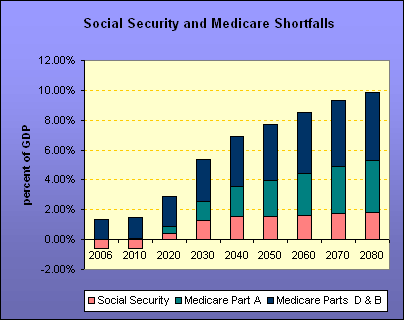
Just as a refresher, here's the picture from the most recent Social Security and Medicare Board of Trustees Report:


The small pink bits at the bottom of each bar represent the SS funding gap. The rest of the bar is the funding gap that the government faces to pay for health benefits that have currently been promised to Americans.

If you really want to tackle the real problem, then you must - must - address the health care funding crisis. I hope to be pleasantly surprised, and find that Bush takes his head out of the sand about that problem at some point during the remainder of his presidency. But I'm not holding my breath.

Monday, October 23, 2006

How Long a Pause for the Federal Funds Rate?

This week the Fed mulls over whether or not to change interest rates. Market participants seem to agree think there's virtually no chance of interest rates being changed, and most economists would concur.

In fact, it seems quite likely that interest rates will remain where they are for a little longer. But perhaps not for too much longer.

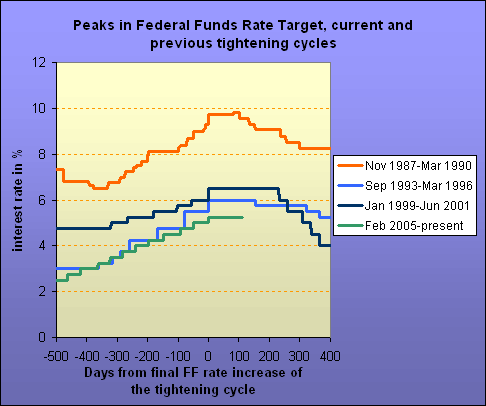
If we look at the three previous episodes when the Fed raised interest rates consistently for a period of time (i.e. tightening cycles), we find that in two of the past three instances the peak interest rate was maintained for only a few months before the Fed reversed course and began cutting interest rates again.


In the third instance (in 2000) the peak was maintained for a bit longer... but as I've argued before, even that seven month pause is short enough that I worry that it illustrates that the Fed has a tendency to overshoot when it raises interest rates.

Of course, it could turn out that after the present pause in interest rate changes, the Fed will see renewed strength in the economy, and decide to resume raising interest rates (similarly to what happened in 1988, with a three-month pause in the rate-tightening cycle). But I don't think so. Right now almost all signs are pointing to moderating growth, not accellerating growth (see David Altig and Jim Hamilton for some other perspectives on this, however). To me, it seems unlikely that that will change anytime soon, because I can't really see what sector of the economy has enough 'umph' left in it to drive a strongly renewed expansion.

That's why my bet is that, in another two or three months, we'll be ready to start looking for interest rate cuts from the Fed.

Good News for Democrats

Apparently the White House continues to stubbornly believe that claiming credit for the state of the US economy is actually going to help them in the coming election. From the AP:
WASHINGTON - With his party facing a difficult midterm election,
President Bush is focusing on the positive this week: a growing economy he is using to try to persuade voters to keep Republicans in power in Congress. [sic]

...Overall, the economy grew at a 2.6 percent pace from April through June, compared with a 5.6 percent pace over the first three months of the year, which was the strongest spurt in 2 1/2 years. Still, voters remain uneasy even though gasoline prices have started dropping, the stock market is hitting record highs, and interest rates on credit cards and adjustable mortgages are leveling off.

...White House political director Sara Taylor said that the economy is a key issue in about two dozen House races... "It's going to have an important impact on certain races around the country," Taylor said. "I think it's an important issue that's not getting a ton of attention."
If the White House suceeds in directing more attention to this issue, then the Democrats are in good shape. Stories like this make me believe that perhaps the Democrats really are going to have a successful election, after all...

Saturday, October 21, 2006

How Should Libertarians Vote?

This week's Economist has an article about libertarians, or as they call it "the neglected swing block":
What's a true freedom-lover to do on polling day?

AMERICA may be the land of the free, but Americans who favour both economic and social freedom have no political home. The Republican Party espouses economic freedom—ie, low taxes and minimal regulation—but is less keen on sexual liberation. The Democratic Party champions the right of homosexuals to do their thing without government interference, but not businesspeople. Libertarian voters have an unhappy choice. Assuming they opt for one of the two main parties, they can vote to kick the state out of the bedroom, or the boardroom, but not both.
Of course, I would disagree with The Economist's assessment of the Democratic Party. The primary way in which most Democrats want to interfere with businesspeople is simply by taxing the very richest of them by a little bit more today - which translates into effectively cutting taxes on them in the future (by reducing the government's debt). But enacting generally increased regulation of business is not high on the agendas of most Democrats.

But this piece reminded me of the interesting debate that has gone on at the Cato Institute (the intellectual home of American libertarians) regarding this question: should libertarians vote Democrat? If you're curious for the details of all of the salient arguments, check out the initial essay by Markos Moulitsas as well as all of the subsequent reaction by numerous thoughtful, well-spoken people.

However, if you don't need all of the details and instead will just be happy with the punchline, then I present to you the list of reasons for libertarians to vote democratic, as originally complied in a classic post by Angry Bear almost three years ago (and very slightly added to by me):
Here's my offer to Libertarians: you've tried the Republicans and that clearly isn't working out, so give the other side a try (and bring your Libertarian friends with you). Here's what you'll get in exchange:
  1. We'll let you sleep with whomever you want to.
  2. We won't force you to pray or otherwise interfere with your private religion.
  3. We won't force you to pay for other people's religious choices.
  4. We still won't let you smoke pot on the public square, but Democrats generally support decriminalization. And we'll do all we can to promote rehabilitation over incarceration.
  5. We won't start unilateral wars without evidence of a real threat.
  6. We won't spend as much of your money as Republicans, though still more than you would like.
  7. For most Libertarians, those making roughly $100k or less, we'll tax you either no more, or less than the Republicans will.
  8. We will generally support free trade at least as often as Republicans.
  9. We will run a smaller government than Republicans.
  10. We will regulate business no more than Republicans, other than by doing more to fight monopoly power and ensure vibrant competition. In fact, we may interefere less with business by no longer playing favorites with some industries over others.
  11. We won't interfere with your reproductive rights and choices.
  12. Despite what you might think, we really won't take your guns away (possible exception: if you are a criminal).
It seems like a pretty good case to me.